
 Nederlands
 English
 Deutsch
 Français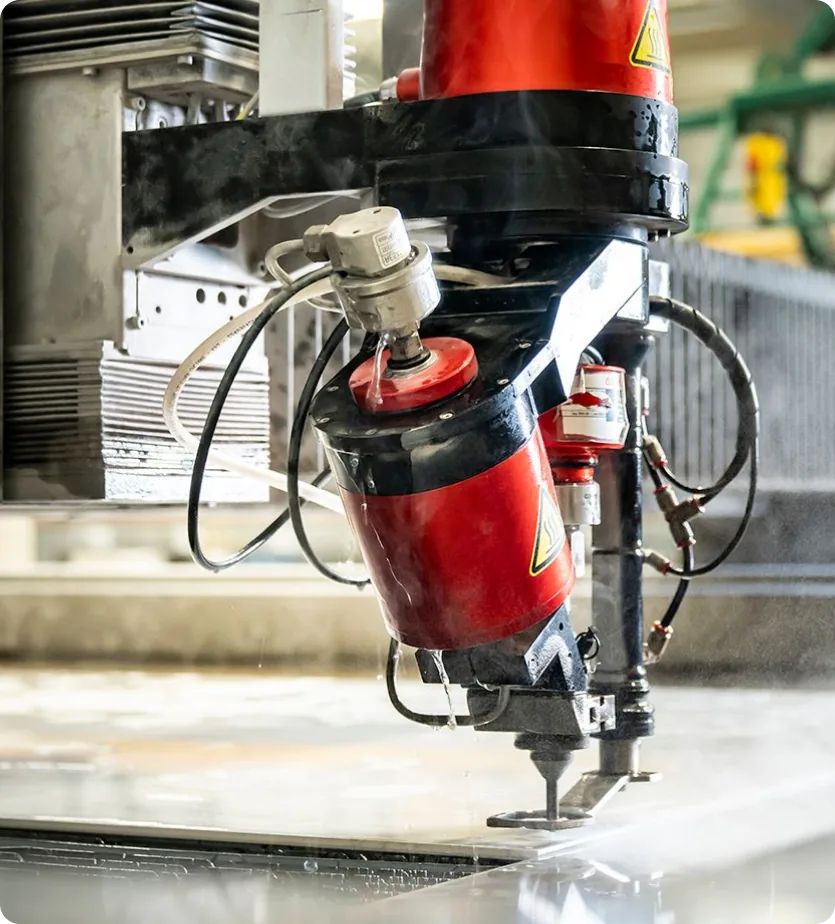
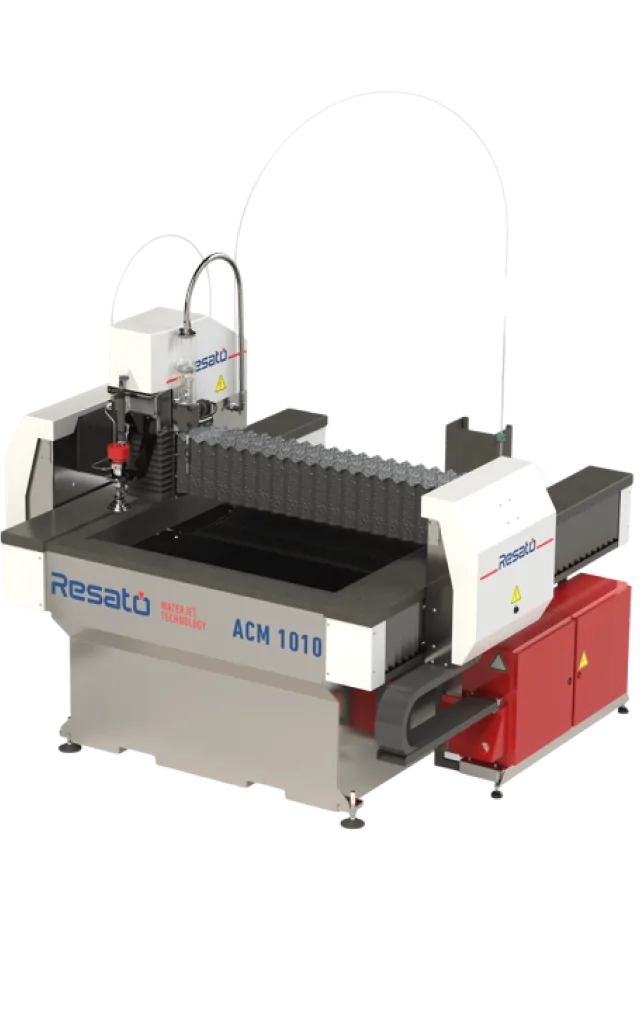

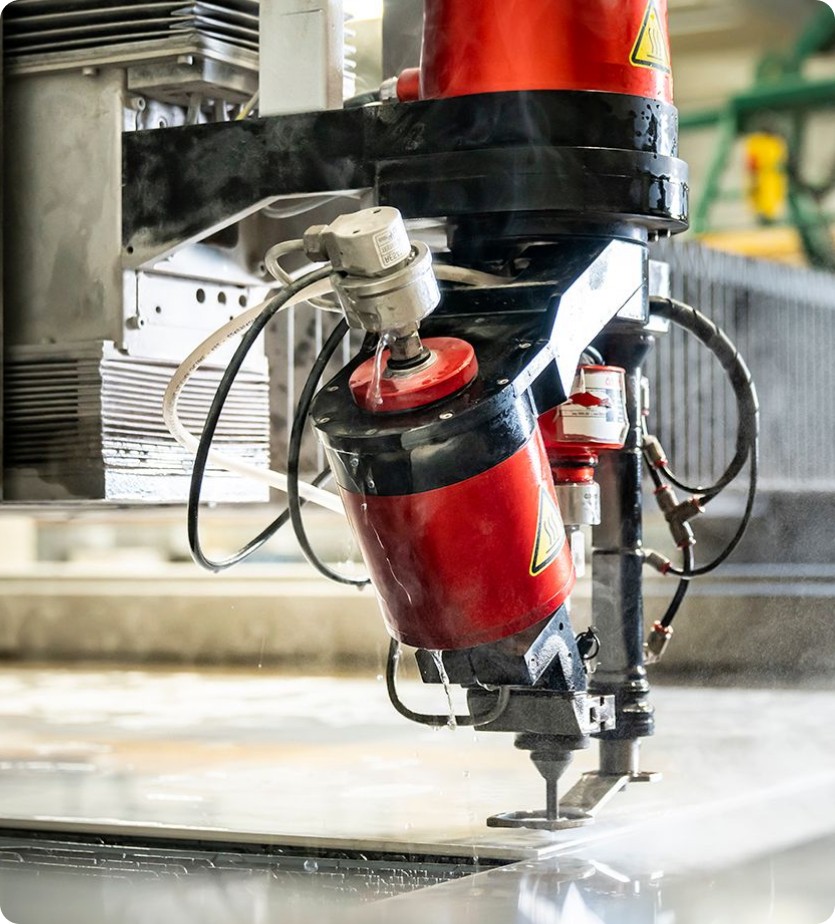
Waterjet cutting comes down to one thing: water brought under enormous pressure and accelerated out through a very fine opening in the cutting head. That jet cuts through almost any material, with no heat involved. Below we go through it calmly: the basic principle, the difference between abrasive and pure water, why it is a cold process, what you cut with it and how stable it is.
The basic principle
It comes down to high pressure. Inside the machine a powerful pump brings water to about 4,000 bar. That is a pressure you can hardly imagine: hundreds of times the pressure in a car tyre. That water is then forced through a very fine cutting head. Through that small opening it emerges at extreme speed, as a thin, focused jet.
That jet does the work purely mechanically. There is no flame, no laser and no electric arc: it is the force of the water itself, and on harder materials the grains travelling with it, that erode the material along the cutting line. The cutting head moves over the workpiece and follows exactly the shape you drew.
What makes the process so stable is the drive that moves the cutting head. Our systems work with a linear, magnetic drive that does not wear. A ten-year-old machine therefore still cuts as accurately as on day one.
Abrasive or pure water
There are two ways to cut with water, and which one you use depends on the material.
Abrasive cutting. On harder and thicker materials we mix a fine cutting sand into the jet, usually garnet. "Abrasive" is simply the trade word for that abrading grain material. The water accelerates the grains and directs them; the grains themselves do the actual cutting. You use this method for metal, natural stone, composites and other hard materials. The grains are mixed in inside the cutting head, just before the jet meets the workpiece. Want to know how that abrasive supply works, from delivery to dosing and removing used abrasive? We explain that under abrasive management.
Pure water. For softer materials you do not need those grains. Then we cut with water alone: textiles, rubber, foam, film and even food. Because no additive is involved, this method also fits the hygiene requirements of the food industry.
Stone always goes with abrasive.
Cutting without heat input
This is the great advantage of waterjet cutting: no heat enters the material. Techniques that cut with heat, such as laser or plasma, heat the edge of the workpiece. A zone arises there whose properties change through the heat, the so-called heat affected zone. The material can melt, deform, harden or crack there.
With waterjet cutting that does not happen. It is a cold process: no melting, no cracking, no hardening and no warping. There is no heat affected zone: the crystal structure of the material does not change, precisely because it is a cold process. That crystal structure is the fixed, orderly build-up of a metal at micro level; if it stays intact, the material keeps its original strength and properties.
You notice that in the cut itself as well. You are left with a smooth cut edge, usually without burrs and without finishing being needed. For applications where the material properties count, from high-grade alloys to aluminium ship parts, that is often exactly the reason to choose waterjet cutting.
What you can cut with it
The short answer: almost anything. We cut a very wide range of materials, including:
- Metal, including stainless steel, aluminium, copper and titanium
- Natural stone and ceramics
- Glass
- Composites, such as carbon and glass fibre reinforced materials
- Foam
- Rubber
- Plastics
- Wood
- Food (with pure water)
The process range runs from 1 to 200 mm material thickness. That is the bandwidth of the technique itself; what is possible in your situation depends on the material and the chosen configuration. Would you like the full list of materials and the details per type? Then read on at everything we cut.
How accurate is it?
The process is stable and highly repeatable. That comes from the linear drive and from the fine abrasive dosing combined with a tightly controlled high-pressure pump. The positioning accuracy is ±50 µm (0.05 mm), and it stays that way across the machine's entire service life. Note: that is the accuracy with which the cutting head positions itself, not the tolerance of your end product. The dimensional result you finally achieve depends on material, thickness and speed.